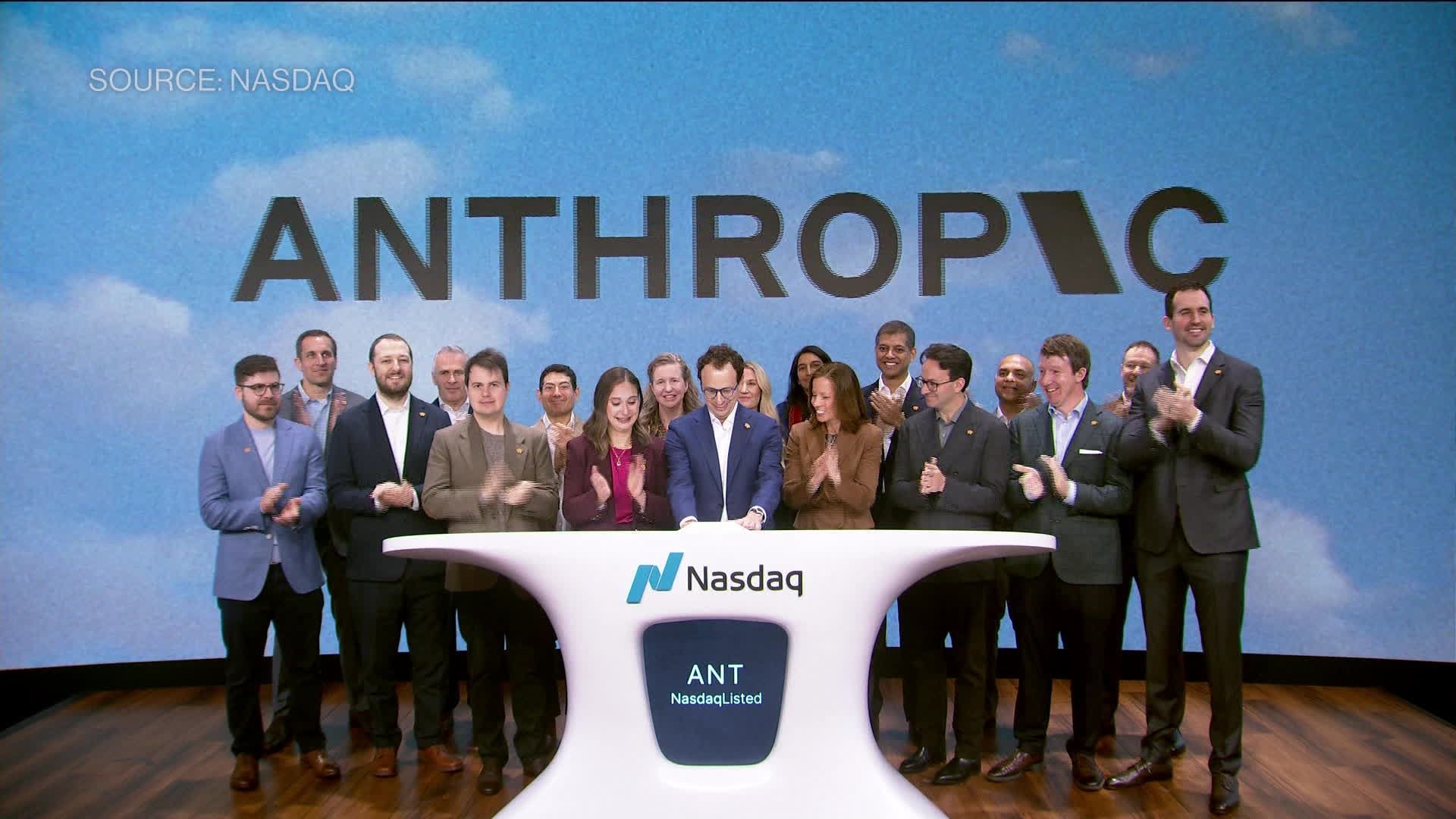
Shares of the Claude developer were down approximately 6.5% at $82 in early trading, compared with Monday’s closing price of $87.64. The decline erased the remaining premium over the IPO price and left the stock roughly 26% below its $111.50 opening trade on November 19.
The reversal follows the largest IPO in history, which raised approximately $93.5 billion after underwriters fully exercised their option to purchase additional shares. Anthropic’s early performance is becoming a test of how much investors are willing to pay for rapid AI revenue growth alongside substantial infrastructure commitments.
How Quickly Did Anthropic Lose Its IPO Premium?
Anthropic priced its offering at $83 on November 18, above its initially marketed range of $70 to $78. The shares opened 34.3% higher the following day at $111.50, briefly pushing the company’s fully diluted valuation above $2 trillion.
The initial enthusiasm faded during the debut session, with shares closing at $97.17. They subsequently declined to $88.91 on November 20, after touching an intraday low of $83.05, just five cents above the offering price.
Monday’s close of $87.64 represented another 1.4% decline despite a broader rebound in AI-related equities. Tuesday’s premarket move took the stock below the level at which institutional and retail investors received IPO allocations.
The selling has coincided with renewed pressure on technology valuations and concerns over rising financing costs. As FinanceFeeds previously examined, Anthropic’s reported market value also varies substantially depending on whether calculations use outstanding shares or fully diluted equity.
Investor Takeaway
A move below the offering price eliminates the initial paper gains for IPO investors but does not directly affect the capital Anthropic raised. The more consequential question is whether the market is reducing the valuation multiple assigned to its future growth.
What Does the $119.5 Billion Capital Raise Mean?
Anthropic’s November 20 closing announcement confirmed that the IPO involved 1.127 billion Class A shares, including 147 million additional shares purchased through the underwriters’ overallotment option.
The offering generated approximately $93.5 billion in gross proceeds, including shares sold by existing stockholders. Anthropic itself received approximately $91.6 billion before expenses.
A concurrent private placement added approximately $26 billion through the sale of Class N shares to technology companies including Google, Nvidia, AMD, Microsoft, Broadcom, Micron and a TSMC affiliate. Combined gross proceeds from both transactions reached approximately $119.5 billion, although not all of that amount went to Anthropic.
A separate regulatory disclosure filed Monday showed CEO Dario Amodei sold 3,378,378 shares worth approximately $280.4 million. The SEC Form 4 identifies the November 20 transaction at $83 per share as a sale to IPO underwriters, rather than a newly disclosed open-market sale at prevailing trading prices.
The filing provides additional information about insider ownership following the listing, but does not establish that the executive’s transaction caused the subsequent share-price decline.
Investor Takeaway
Anthropic’s substantial capital raise strengthens its financing position regardless of near-term stock movements. However, the distinction between company proceeds, existing-shareholder sales and strategic private-placement investments is essential when assessing the amount available for future spending.
Why Are Investors Reassessing Anthropic’s Valuation?
Anthropic’s IPO prospectus reported revenue of approximately $33.2 billion for the nine months ended September 30, 2026, compared with $2.5 billion in the corresponding period a year earlier.
Its operating loss narrowed to approximately $1.3 billion from $5.2 billion. Third-quarter revenue reached approximately $17 billion, although the company reported a $567 million operating loss during the quarter.
The growth comes with significant infrastructure obligations. Anthropic disclosed approximately $900.9 billion in aggregate purchase commitments and lease agreements, substantially related to computing infrastructure, extending through 2045. Approximately $70.7 billion was due within 12 months of September 30, 2026.
These commitments are not equivalent to immediately outstanding debt, but they create long-term funding requirements dependent on continued customer demand and access to capital.
FinanceFeeds reported that prospective bond investors were scrutinizing these obligations even as equity investors assigned Anthropic a trillion-dollar valuation.
At September 30, Anthropic held approximately $95.6 billion in cash and cash equivalents and $36.3 billion in short-term investments, before the completed IPO and private placement.
Can Index Demand Support the Stock?
Additional institutional demand could emerge as Anthropic enters major equity benchmarks. MSCI is expected to add the company to its global standard indexes following the November 30 close, potentially prompting purchases by passive investment funds.
Such demand would be distinct from investors buying shares based on earnings expectations, and its eventual scale remains uncertain.
The company’s record Nasdaq listing has established a public valuation benchmark for frontier AI developers. Sustaining that valuation will depend increasingly on whether revenue growth translates into durable operating margins and sufficient cash generation to fund computing investments.
Investor Takeaway
Index inclusion could create incremental share demand, but it does not resolve concerns about profitability or infrastructure spending. Investors will need to distinguish technical buying associated with index rebalancing from sustained demand supported by the company’s financial performance.